
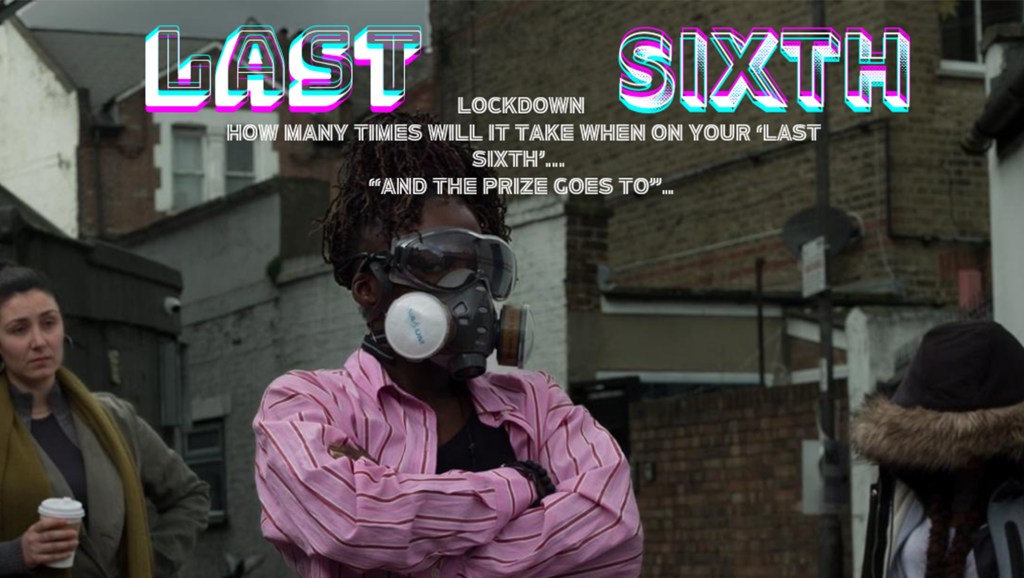
Every now and again, you’re reminded of the power of theatre. Traditionally, we gravitate towards the West End shows with its high-value productions starring the latest star from Hollywood. But the most fascinating space is when we step away from the traditional showbiz glitz and glam, to venture out to local and community productions, a space where writers can ambitiously tell their stories. And even when the production value is not always present, it doesn’t matter. With storytelling as the main focus, allows for boundaries to be pushed or tell stories not covered nearly enough by the mainstream.
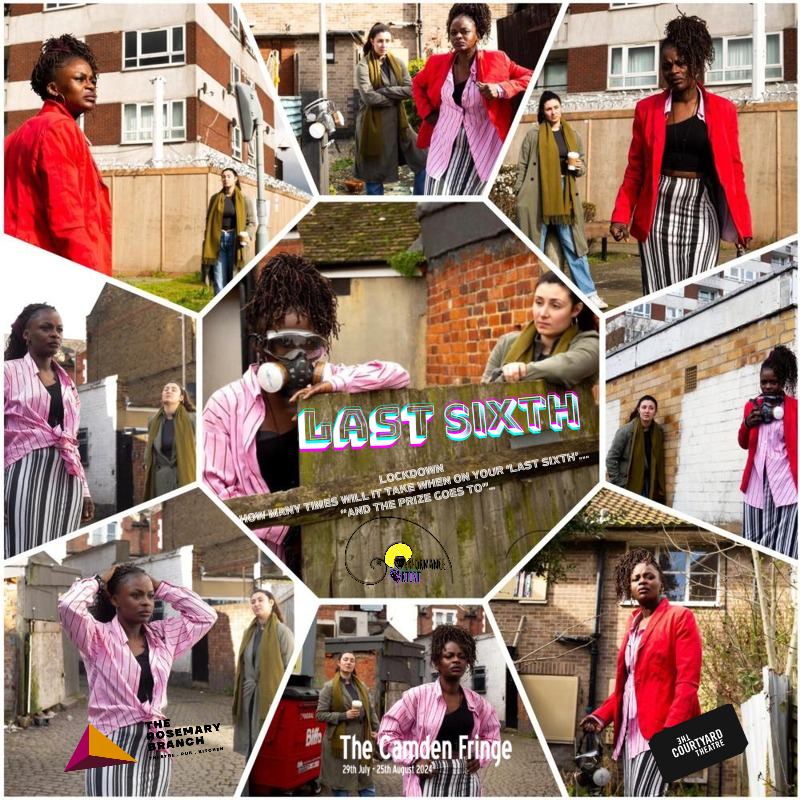
That was the experience watching Olayinka Sobitan-Solomon’s Last Sixth at The Courtyard Theatre in London. The play, part of this year’s Camden Fringe (the rebel alternative from its Edinburgh counterpart), is a raw and uncompromising examination of relationships through the drug-filled haze of addiction. For a hard-hitting subject matter, it’s not for the faint of heart and therefore trigger warnings apply. Yet with strong performances and imaginative staging, the play strikes a chord long after it ends.
Sixth’s story takes place at the height of COVID, starting off with clips of the former Prime Minister Boris Johnson delivering his coronavirus speech on lockdown (rules to which he himself didn’t adhere). Solomon (who wrote, directed and composed the music) doesn’t look through this period with any sense of nostalgia. There’s no clapping for the NHS or staying at home to perform a civic duty – we jump straight into a queue-fight over toilet rolls! As the story slowly emerges, Sixth escapes the time capsule bubble by acting more as a chaotic catharsis for its leading character Tracy (played by Olayinka Sobitan-Solomon). Through her viewpoint, we witness a country psychologically gripped by fear intertwined with the self-destructive nature of her addiction, recovery and subsequent desire to reconnect with her daughter.
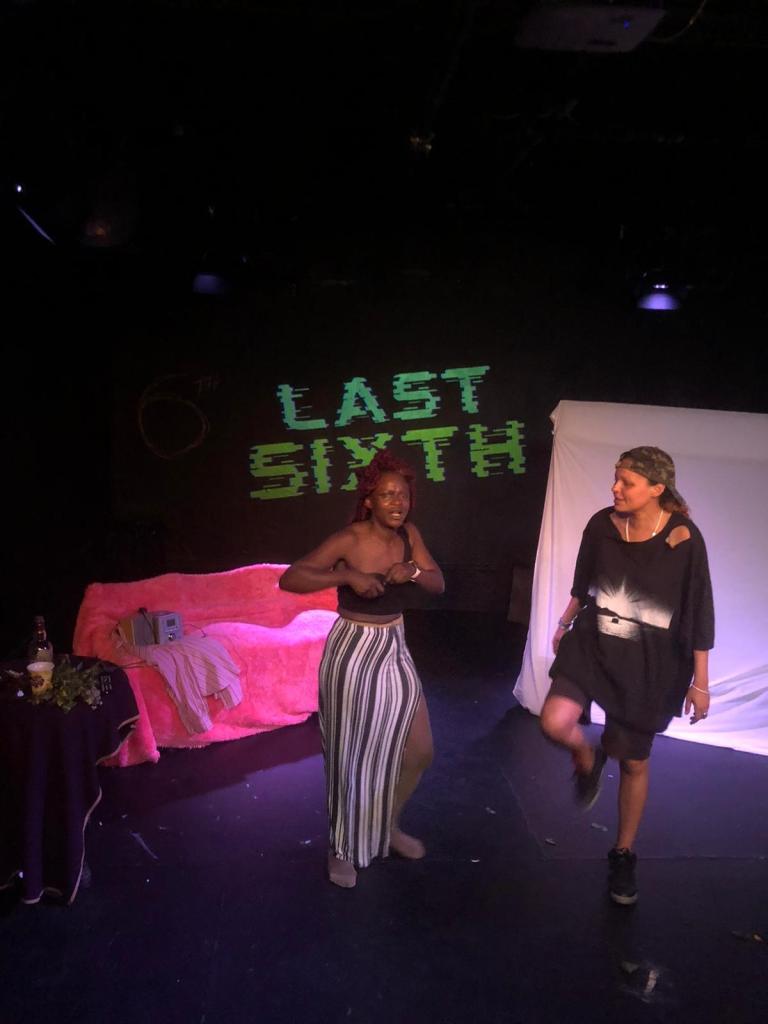
Solomon’s commitment to playing a complex, flawed, eccentric, messy and unapologetic character, comes to fruition. Through a series of chaptered vignettes, Solomon’s writing and performance subsequently opens the door then dropkicks her audience straight into the mindset of an addict. The addictive tics, her erratic conversations with her social worker, the rapid on-screen costume changes, to the random trains of thoughts, coalesces into a state of a “highs”. That’s when the production finds its groove with its lighting design, using colour in amplifying Tracy’s euphoric mood and inner thoughts. And it’s never afraid of being unconventional, I mean, how often do you see a passionate monologue dedicated to a crack pipe?
The play’s frequent breaks between its darkly comedic mindscapes and dramatic reality proves effective in one notable scene where Tracy meets up with her dealer. With a spotlight focussed on her, she randomly bursts into song, culminating into a remixed version of Usher’s ‘Nice and Slow’. On a bigger budget, you could imagine a broadway style musical akin to Singin’ in the Rain, full of the showbiz swagger and magic that Gene Kelly possessed in abundance. But for now, in its minimal staging and silhouetted production design, the intention was slightly spoiled by a few technical difficulties during its matinee performance.
But you can tell that Last Sixth’s origins started life as a ‘one-woman show’, the story fleshed out to add context for Tracy and her lived experience. But it can also feel somewhat lightweight. For a short play lasting roughly about 45 minutes, it’s covering a lot of ground in its fast paced exploration, and some elements such as the daughter storyline don’t go emotionally deeper than what is presented on the surface.
Where it regains its strengths is in its centrepiece moment. Tracy – pushed to her limit – decides to change her life, delivering a powerful monologue directly to the audience on the effects of going ‘cold turkey’. A questionable sound design almost takes away from the scene’s poignancy, walking on a fine tightrope between seriousness and that darkly comedic edge from its earlier scenes. But it just does enough to make it worthwhile with Tracy’s notable fear, anger and helplessness are all laid bare for everyone to witness.
There’s clearly more scope and room Solomon wants to pursue with Last Sixth. Solomon passionately delves into a story centred from the female experience without resorting to stereotypes or biases. Behind the inventive swings are moments of sincerity and empathy, a feeling that rings true especially during a time when the vulnerabilities of addiction are still felt and present around us in our community. You only have to walk around the streets of London to see its harmful effects on the homelessness for example. With a bit more of a gracious running time, you sense Solomon will realise the play’s full potential. But for now, it’s a promising adventure towards a complete and enriching story.




 Confessions From A Geek Mind
Leave a reply to Olayinka Sobitan-Solomon Cancel reply